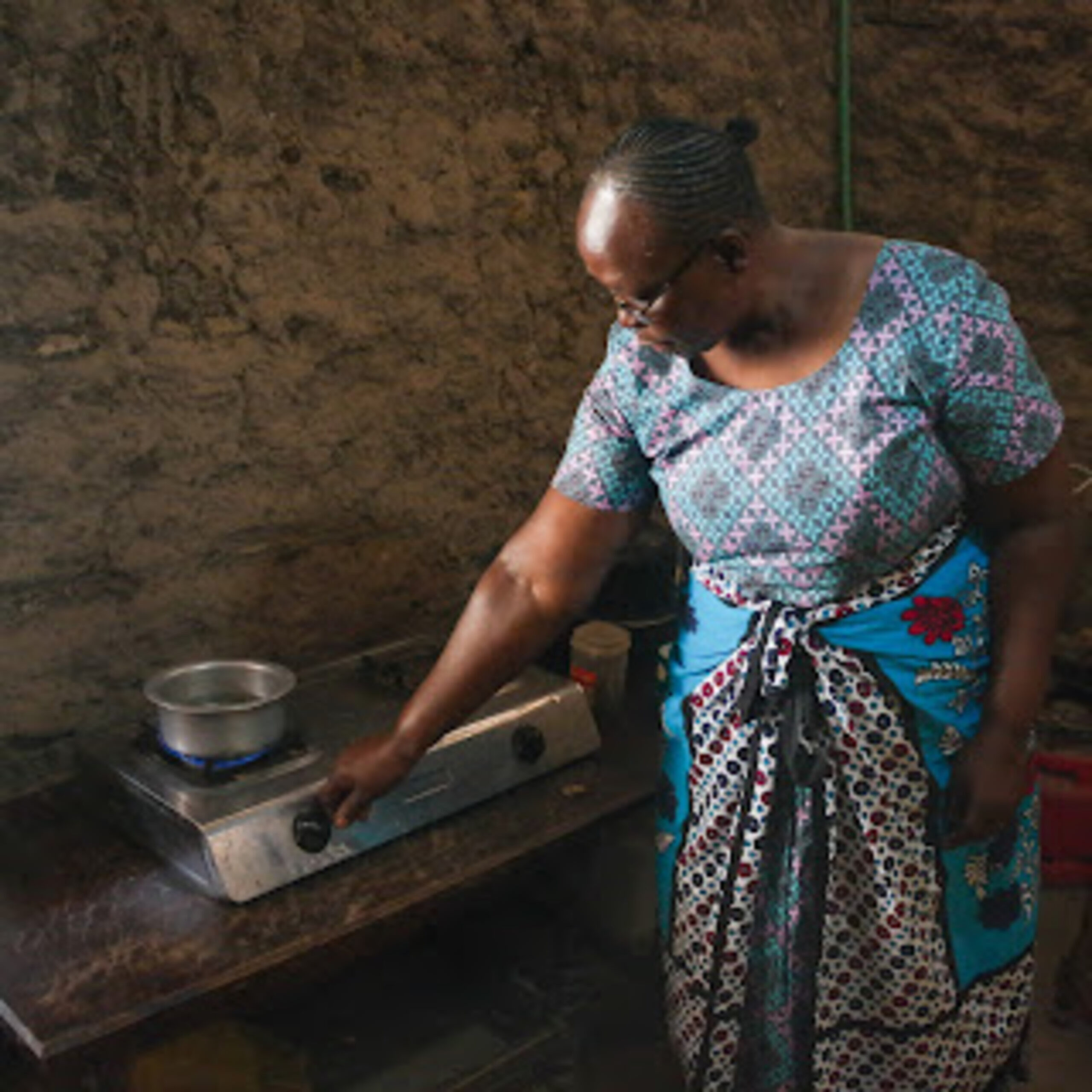
Juliana Fondo lighting her jiko which uses Biogas. Photo by Captain Nyota.
For over five years, Selina Juma, a mother of five and grandmother of ten, had to walk over five hours to seek health services for one of her grandchildren, who suffered from persistent coughing. Selina was unaware that the primary cause of her grandchild’s respiratory illness was the smoke from the firewood she used for cooking, meaning they had no access to clean air in their home.
In Kenya, indoor air pollution from burning firewood, charcoal, and kerosene damages infants’ developing lungs, contributing significantly to respiratory diseases and in some instances even pneumonia. Exposure to smoke is a major risk factor for pneumonia, which is a leading cause of death for children under five in Kenya. Studies show that exposure to solid fuel smoke increases the risk of pneumonia by 80% and is linked to higher rates of coughing, wheezing, and other respiratory illnesses in young children in rural Kenya.
The world observes World Pneumonia Day every November 12th. The day aims to raise awareness about pneumonia and emphasizes the necessity of prevention strategies, such as vaccination, better nutrition, and access to clean air, alongside urgent treatment like oxygen therapy and addressing antibiotic resistance. This year’s theme is “Every Breath Counts: Stop Pneumonia in its track”.
To reduce infants’ exposure to smoke and their chances of developing pneumonia, women in Rabai Village, Kilifi County, have adopted clean cooking fuels that are both economical and safe, such as biogas, to ensure clean air in their homes. The use of biogas has simplified their work, it is clean, produces no smoke, and allows them to cook anytime without the fear of running out of fuel.
Selina, who is from Makobeni village in Kilifi County, used to walk over five hours to a Kaya forest just to find firewood, which was her main cooking method. But in 2016, while visiting a dispensary for her grandchild’s medicine, she was educated on alternative, clean cooking methods and the importance of having access to clean air.
“I used more than Ksh 5,000 every month to look for medication for my grandchild, but it reached a time that I was not able to afford the cost because I don’t have a permanent job,’’ she said.
“So when I was introduced to biogas and since I had two cows, I decided to make mine and have a clean cooking method to save my grandchildren from getting any respiratory diseases like coughing, asthma, and even sometimes pneumonia,” she added.
Since Selina started using biogas, her grandchild’s health has improved, with no regular coughing, fever and fewer hospital visits.
To produce biogas, the women gather cow dung from their zero-grazing units. They put the dung into a mixing chamber, where it’s crushed by hand into finer particles and mixed with water.
This mixture is then transferred to a digester with a gas holder, where the bio waste undergoes anaerobic digestion to generate methane gas, which is flammable.
The methane gas is then piped into the house for cooking and lighting. The used waste is collected in a final tank, this substance, called slurry, is then utilized as fertilizer.
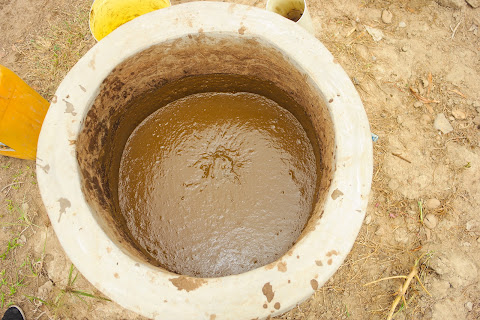
According to the 2019 national census, Kilifi County has a population of 1.4 million, with a poverty rate of 48.4%. Most residents use firewood as their primary cooking method, often obtained by cutting down trees in forests.
Health experts warn that the frequent use of firewood endangers children’s lives because the smoke produced is inhaled into their lungs. Doctor Penina Mkoji, a pediatrician, explained that when children are exposed to smoke, their still weak lungs can develop chest and lung problems.
“When children are exposed to smoke, most of them might end up having chronic diseases like asthma, Tuberculosis and others even develop pneumonia,” she said.
Dr. Mkoji added that the smoke from firewood often makes it difficult to breathe properly, which can lead to long-lasting health problems for children. Because most respiratory diseases are long-term, they become very expensive for parents to treat as their children grow up.
Many families in Kilifi County are now embracing the use of biogas to secure clean air and reduce the chances of their children contracting respiratory diseases, including pneumonia.
In Pangayambo village in Kaloleni Constituency, Peter Wakesho and his wife Eunice Wauda have been using biogas for over five years. Peter said that they previously used firewood, but the smoke affected the health of his wife and children.
“I completely switched away from using firewood. You know, even doctors say that if you inhale the smoke, one can get Tuberculosis and breathing problems because of that smoke. But if you have this biogas, it’s clean. My wife used to cough a lot when she was cooking with firewood, but now I see her being cheerful no coughing problems, and no stress,” he said.
Juliana Fondo, a mother of five from Mikomani village, Rabai Sub-county, has been using biogas since 2018. The dung from her six cows is “gold” to her, as she uses the waste to run her biogas stove for cooking. Before switching to biogas, Fondo said she would spend many hours looking for firewood and charcoal, which she felt was unhealthy for her family.
“The biogas has made my work easier, it is very clean, no inhaling of smoke and I can cook anytime without fear that it will run out. It can be used for eight hours of non-stop cooking for my family of five children,” said Ms Fondo.
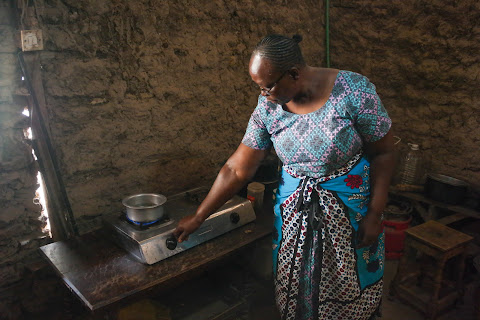
Stanley Tinga and his wife Jane Tinga in Bandara Salama village, Chonyi, Kilifi County, have also been using biogas for more than five years. Both are retired health sector workers who now engage in agribusiness, running a dispensary on their three-and-a-half-acre piece of land. They act as role models by raising awareness about the benefits of clean cooking methods.
Jane explained how biogas has personally helped her and her grandchildren against respiratory diseases.
“Biogas is good, I really love it. The good thing about biogas is that you don’t use many things, it’s just cow dung and water only. And it has helped me because I am asthmatic, so I avoid smoke a lot, together with my grandchildren,” she said.
Statistics from the United Nations Environment Programme (UNEP) indicate that one in every three people worldwide uses cooking methods like firewood and produce smoke that is harmful to health and the environment, causing various diseases, including lung cancer. UNEP notes that most cooking activities occur indoors, and the smoke produced carries toxic particles. This indoor air pollution according to their statistics resulted in the premature deaths of 3.1 million people in 2021.
According to the 2022 demographic health report, only 9% of Kilifi County residents use clean cooking methods. This low figure puts residents at a high environmental risk that can lead to lung diseases, particularly in children. A recommendation from the same report is to increase the number of families using clean energy or gas for cooking from 9% to 40% to reduce cases of children developing lung or respiratory diseases.
One challenge the women encounter with biogas is a lack of water for mixing the cow dung. Furthermore, due to climate change and resulting long droughts, cows cannot get enough grass to feed on, leading to very little waste production.
Doctor Penina Mkoji, however, insists that families embrace clean cooking methods so as to have access to clean air and reduce the cases of children getting respiratory diseases and even pneumonia.
“Most families use the same house for sleeping and also cooking, so I normally advice women to cook outside and places where there is enough ventilation where children cannot inhale the smoke. And also I advise them to use clean cooking methods for good health of their children,” she concluded.