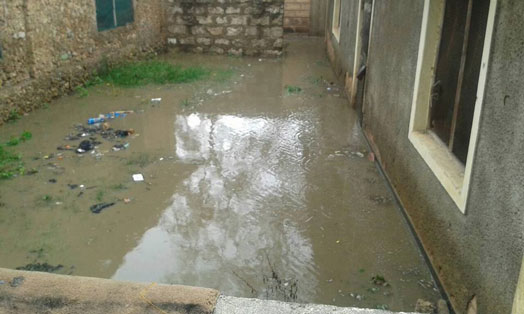
Houses submerged by flood water due to poor drainage in an estate in Mombasa County| Photo Courtesy
Residents and traders in Kongowea and Mtopanga, Mombasa County are raising alarm over a worsening drainage crisis that is threatening livelihoods, public health, and infrastructure in the area.
In recent weeks, heavy rains have turned major roads and market areas into swamps, with raw sewage mixing with stagnant rainwater. The resulting floods have submerged footpaths, market stalls, and residential roads, leaving communities grappling with foul smells, disease outbreaks, and economic losses.
“Every time it rains, it’s the same story,” says Josephine, a fruit and vegetable vendor in Mtopanga. “The roads flood with dirty water and sewage. I lose stock, customers avoid my stall, and I fear getting sick.”
Kongowea, known as the largest open-air market in the coastal region, has long suffered from poor drainage infrastructure. Residents accuse the county government of only offering short-term fixes such as temporary unclogging, which fail to prevent recurring floods.
According to residents Alfred Mutua and Bosko Chalo, the situation has been made worse by poor waste disposal practices, lack of regular garbage collection, and illegal dumping. They also blame unplanned urban development and the construction of buildings over natural drainage paths.
“The county only comes when the situation is already out of hand,” said Mutua. “They remove garbage and silt, but it doesn’t last. We need permanent solutions, not these short term solutions.”
Moreover, health professionals are also raising concerns. Sarah, a pharmacist at Fanaka Mtopanga Pharmacy, notes an increase in cases of waterborne diseases.
“We’re seeing more patients with cholera, typhoid, and dysentery. Stagnant water mixed with sewage is a serious health hazard, especially in these densely populated areas,” she said.
Hotel and business owners echo similar concerns. Juliana, who owns a local hotel, says customer numbers drop significantly during the rainy season due to the bad smell and unsafe conditions.
“It’s not just flooding, it’s a public health and economic disaster,” she said. “Children get sick playing in the dirty water. Some homes don’t even have proper sewage pits, and it worsens the spread of disease.”
However, Boda boda (motorcycle taxi) riders like Ibrahim Kalawa say the waterlogged roads damage their bikes and cost them business.
“It’s not only the government’s fault. Some residents throw garbage everywhere, blocking the drains. We all have a role to play,” Kalawa said.
According to Douglas, a resident of Mtopanga, every rainfall turns his compound into a pool of water.
“There’s no way to pass. I have to use a longer route just to get into my own house. Mosquitoes breed in the stagnant water, and many people are suffering from malaria,” he said.
Further Mtopanga Chief Said Chuma says that some cases of drainage systems are still in the court and they acknowledge the problem, admitting that much of the drainage systems are no longer able to cope with current demands.
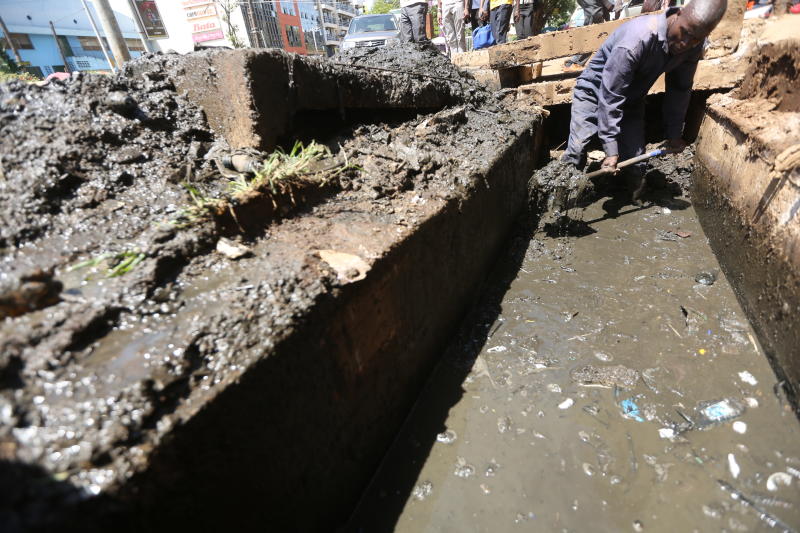
With climate change causing more unpredictable and intense rainfall, residents warn that without a complete improvement of the drainage infrastructure, flooding will become more frequent and more destructive.
As the rainy season continues, residents of Kongowea and Mtopanga are getting ready for more chaos and more damage. Mike, a businessman in Kongowea says that there is a need for a proper drainage system, better waste management, and cooperation between the government and the community.
It is a call for urgent action from both the county and national governments, as well as from the private sector. Residents and stakeholders are urging for a long-term, sustainable drainage plan to address not only the flooding but also the growing public health risks.
Mohamed Ali, the Member of Parliament for Nyali has emphasized his commitment to improving the lives of residents in Mombasa County. He stated that as the MP for Nyali, he has worked tirelessly to mobilize resources and secure development funds aimed at uplifting the community. He emphasized that it is now the responsibility of the county government, under the leadership of the governor Abdulswamad Shariff Nassir, to ensure that essential services such as an efficient drainage system are implemented effectively.
According to Mohamed, poor drainage systems fall under the mandate of the devolved units, and it is their duty to deliver on such fundamental services for the benefit of the people of Mombasa County.