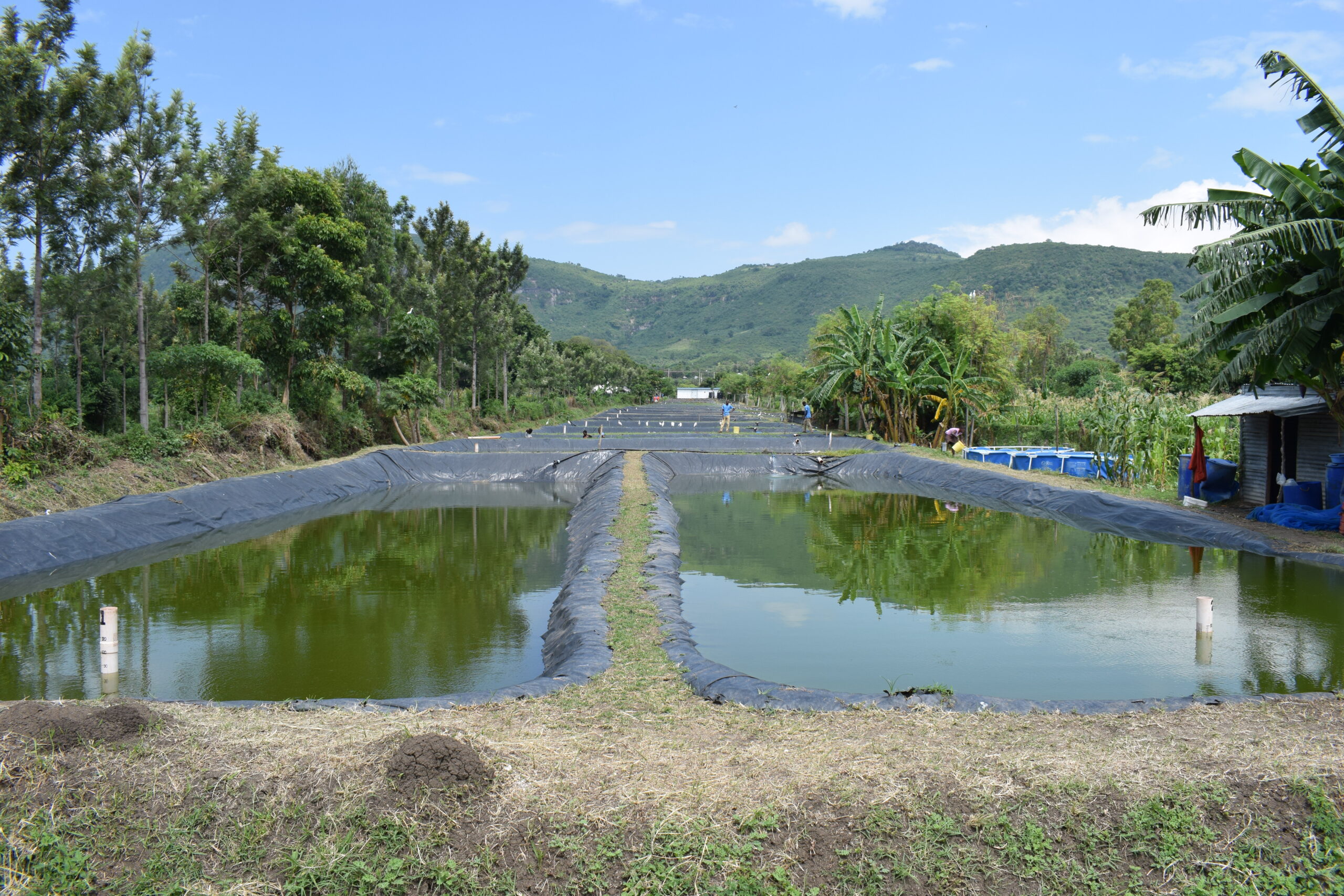
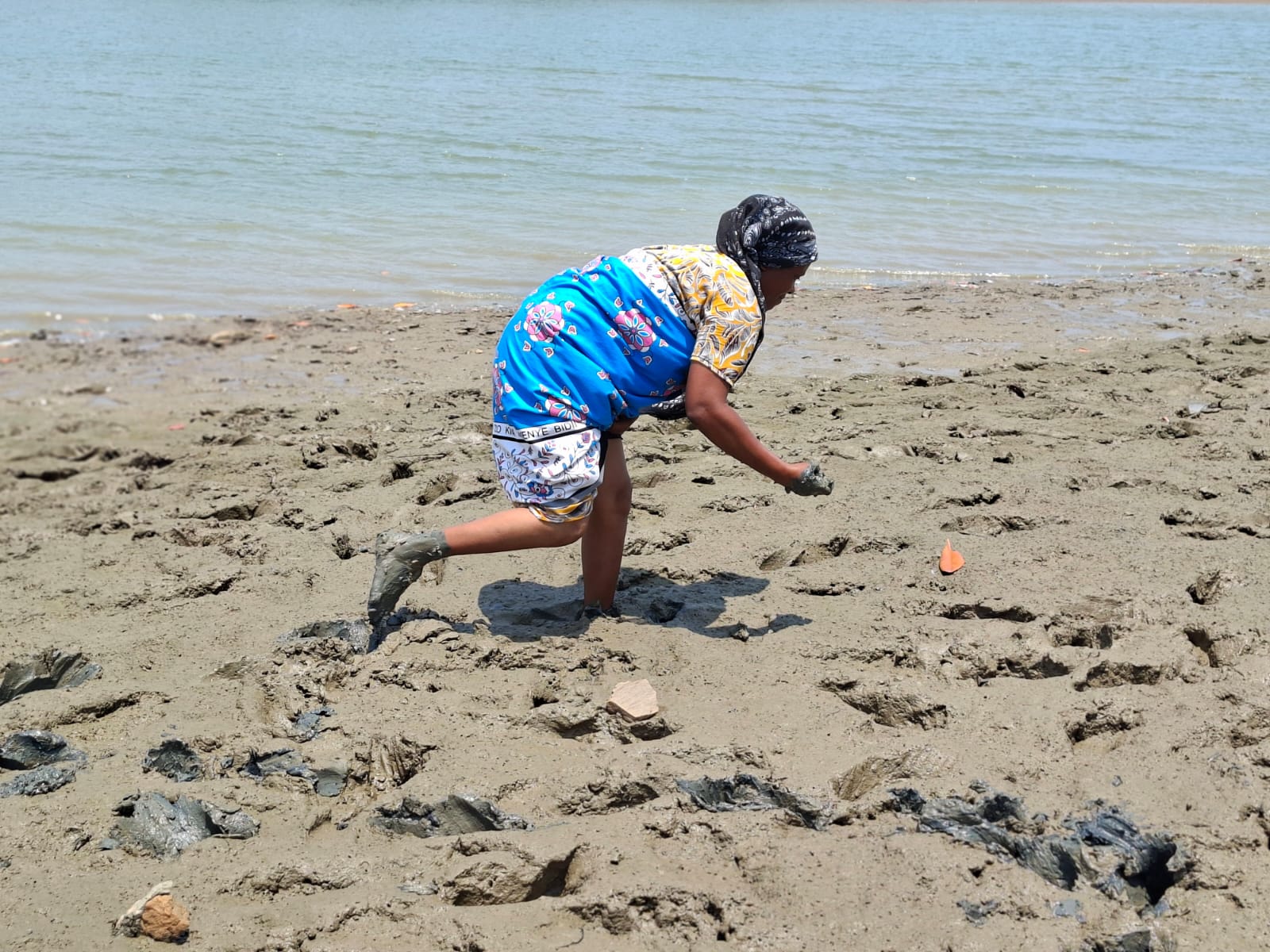
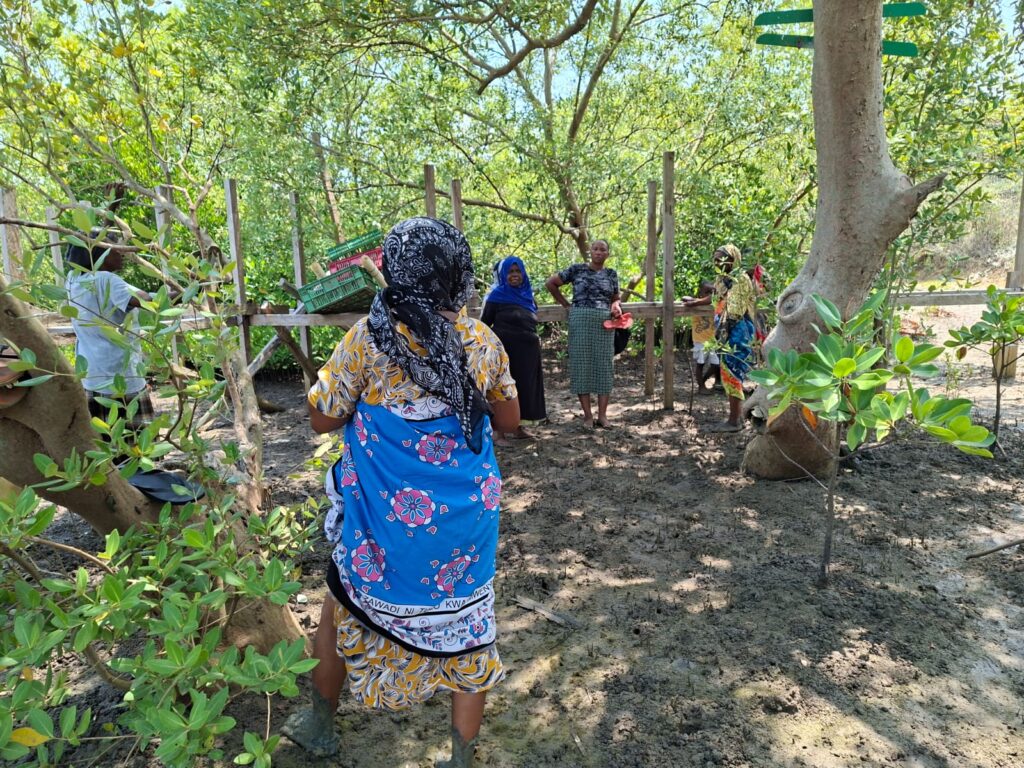
One of the group members looking for snails which and little fish used for feeding the crabs. Photo by Asha Bekidusa.
In the humid, salt-slicked air of Jomvu Creek, Mombasa County the narrative of women in fish processing and distribution is changing. Initially women here were known as mama karanga meaning women fish fryers. These women spent their lives over hot bubbling oil, frying the day’s catch to feed a growing population in the area. But now, the smoke is clearing. In its place is a women community-led organisation that blends indigenous knowledge with conservation as they are determined to change their lives. Now women pioneers are fattening mud crabs, a venture that is proving to be both a climate change and challenging gender inequality.
At least 500 metres up a hilly road from the mangroves of Mombasa County, a group of 14 women gather in a small hall. Here there is a chama ,a traditional informal savings and loan group but the conversation here is not only on money lending and savings. The conversation here is about tidal waves, water salinity, cage integrity, and mangrove survival rates.
This group Jomvu Women in Fisheries and Culture has transitioned from the usual chama to a women empowerment .Dwindling wild fish stocks and the health toll of respiratory diseases from cooking fires forced a rethink.
“I spent 30 years as a mama karanga,” says Mwaka Chirima, the group’s treasurer. “The doctor had advised me to stop, or the smoke will finish you.”
In 2021, the group secured a Ksh 2.7 million grant from the Kenya Marine Fisheries and Socio-Economic Development (KEMFSED) project. This is where the change began.
While half the original members dropped out fearing that women over 30 couldn’t handle the physical and technical demands of aquaculture, 14 women and three “male champions” continued with this project.
The group focuses on the Mud Crab (Scylla serrata), often called the giant mangrove crab. These crustaceans are highly valued for their sweet flesh, but they are also vital ecological indicators.
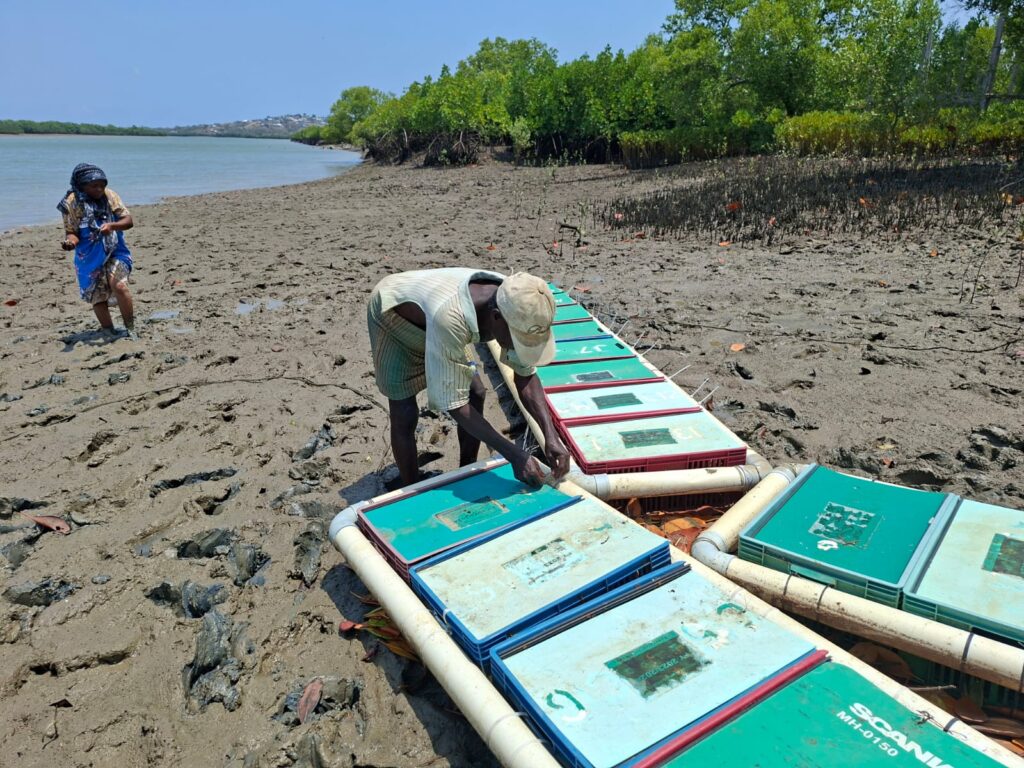
They began collecting juvenile crabs from the wild and putting them in cages. Using funds from the KEMFSED grant, the women use repurposed plastic bread crates as cages, tethered in tidal creeks.
The crab follow a strict feeding programme of one day on, one day off of small fish, shrimp, and marine snails who are sourced just within the creek.With each crab taking between 6 to 8 weeks to reach a harvest weight of 800 grams to 1kilogram from the initially 300 grams or less when collected from the wild.
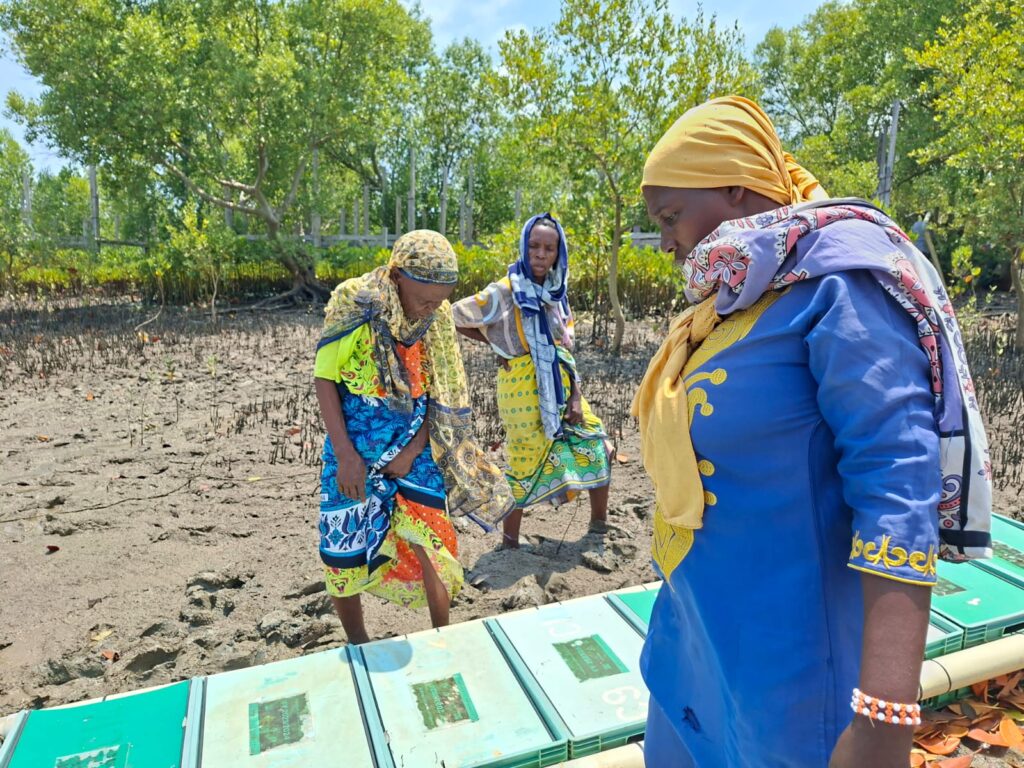
According to David Mirera, Principal Research Scientist at the Kenya Marine and Fisheries Research Institute (KMFRI), crab fattening prevents post-harvest loss. Historically, fishers would keep crabs for days in poor conditions, leading to high mortality rates. Now, the women keep them alive and thriving in their natural environment until the moment of sale.
As the global blue economy turns toward high-tech solutions, a digital divide is emerging along the Kenyan coast. While artificial intelligence is increasingly used to track fishing vessels, model fish stocks, and predict ocean conditions, the women of Jomvu operate far outside these digital systems. None of the women had ever heard of satellite-based crab stock models. Yet each could tell, by smell and soil texture, whether the creek was healthy enough to support another cage.
Additionally, none of their decisions are guided by apps or algorithms. Instead, they rely on tides, touch, and knowledge passed between women over decades. This makes them as small-scale producers left out in the emerging AI-driven fisheries management, technologies meant to protect oceans.
The group represents a missed opportunity for the AI revolution. Currently, AI systems are built around industrial priorities, mapping vessel movements or optimising large-scale yields. They often overlook the granular, localized data that women-led conservation groups possess.
The relationship between the women, the crabs, and the mangroves is a symbiotic in circular ecology. The crabs burrow into the mud, aerating the soil for the mangroves; the mangroves, in turn, provide the shelter and nutrients the crabs need to thrive. The women thrive in their conservation effort by doing so.
However, when the journey started challenges were experienced. Just three weeks after their launch, a massive tide tore the cages free, dragging their entire investment two kilometers’ away. However, with the help of the community and families they were able to assist them and they began again from zero after all the crabs were washed away by nature.
Also the plastic crates used for cages degrade under the harsh sunny weather and brackish water in the coastal areas.
Despite this, the economic impact is undeniable. While a mama karanga might earn Ksh 200 a day, a single fattened crab can now fetch nearly Ksh 900 . In a good month, the group nets Ksh 40,000. It might not be much in economical standards but a modest amount for women who were once in the village not having a steady income.
This success of the Jomvu women is a victory over deep-seated cultural barriers. Mercy Mghanga, founder of the Coastal Women in Fisheries Entrepreneurship, points out that for generations, some coastal cultures barred women from owning boats or taking loans without male consent.
“If a woman is married at 16, will she go back to school?” Mghanga asks. “We must give her other paths to learn, to earn, and to lead.”
This is exactly what the Jomvu group is doing, giving women paths to earn and learn. They are currently seeking funding to extend a 180-meter mangrove boardwalk. This infrastructure is not just for ease of access to cages, it is also a foundation for an eco-tourism venture. They are training members as tour guides, turning their conservation site into a classroom for school groups and tourists.
For Bonface Busolo, Chief Technical Advisor for mariculture and environmental conservation, the Jomvu project demonstrates a delicate but hopeful balance between livelihood and conservation.
Busolo notes that at this scale, the environmental footprint is minimal. “They’re using local cages and natural feeds. There’s little risk of pollution. But as such projects expand; Kenya must adopt clear environmental guidelines.”
He stresses the need for scientific monitoring. “Communities often assume that because the crabs are healthy, the creek is fine. But we must also measure water salinity, temperature, and oxygen to truly understand the impact.”
The Jomvu women are growing a new model for coastal resilience. They have proven that when you empower women they heal the ecosystem.
“If the mangroves die, the crabs go,” says Charity Baya, the group’s chairperson. “And if the crabs go, our business dies too.”
This article was produced as part of the Gender+AI Reporting Fellowship, with support from the Africa Women’s Journalism Project (AWJP) in partnership with DW Akademie.